Emilia's Graces
Granola made with grace, not gluten
Full Branding and Website Redesign using Shopify
The Challenge
Emilia's Graces is a Harrisonburg-based, certified gluten-free granola brand producing more than a dozen distinct flavors. As one of the few certified gluten-free granola producers in Virginia's Shenandoah Valley, the brand occupies a meaningful niche — combining simple, wholesome ingredients with a strong local identity.
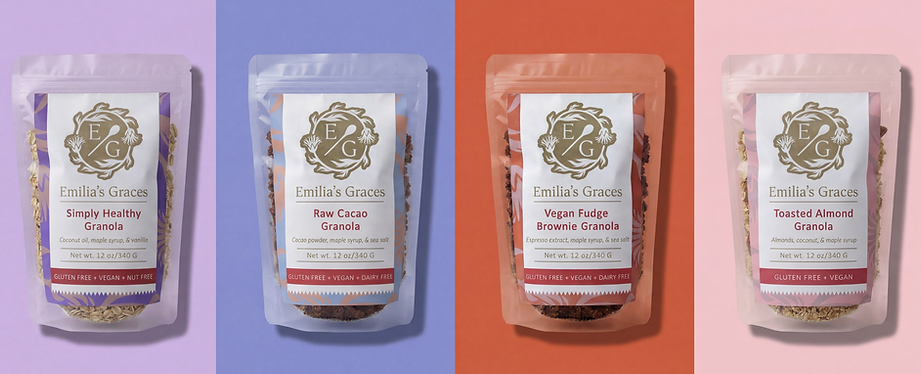
As the business grew, its original digital presence struggled to keep pace. The existing website made it difficult for customers to differentiate between product offerings, lacked clear information about where to purchase granola locally, and was not built to scale alongside increasing demand. Visual inconsistency across the site and marketing materials further eroded trust and diluted the brand's handcrafted identity.
The Granola Girlies™ — a three-person team of designers, strategists, and developers — were engaged as part of the SMAD Capstone program (Spring 2026) to address these challenges holistically, delivering a full branding and e-commerce overhaul that would position Emilia's Graces for sustainable growth.
Goals
Goal 1: Strengthen Brand Identity
Establish a cohesive, professional visual language, including logo, color palette, typography, and product labels that reflect the brand's handmade, local character and can scale consistently across both print and digital touch points.
Goal 2: Improve Product Clarity
Solve the differentiation problem by introducing professional product photography, clear dietary attribute badges, and intuitive navigation so customers can quickly identify, compare, and select their preferred granola flavors with confidence.
Goal 3: Build a Scalable E-Commerce Experience
Migrate the brand onto Shopify to create a platform capable of handling growing inventory, increased order volume, and wholesale relationships without sacrificing the warmth and personality that define Emilia's Graces.
Goal 4: Drive Social Media Engagement
Develop a ready-to-use social media system, including Canva post templates, a structured content calendar, and branded assets, that enables consistent, on-brand content creation across Instagram and Facebook beyond the project's conclusion.
Research & Analysis
Before any design or development work began, the team invested significant time in understanding the competitive landscape, industry best practices, and the specific behavioral patterns of Emilia's Graces' customer base. This research phase informed every strategic and creative decision that followed.
Competitive Analysis
Three comparable gluten-free brands were selected for benchmarking: BOLA Granola, Nana Joe's Granola, and Emmy's Organics. All three share key characteristics with Emilia's Graces — they operate on Shopify, produce in small batches, hold gluten-free certifications, and serve a mix of direct-to-consumer and wholesale customers. Analyzing their digital strategies revealed both industry standards and meaningful gaps.
-
Dietary attribute icons (GF, Vegan, etc.) reduce friction and help users quickly identify safe products
-
Image-rich navigation with product thumbnails significantly improves product discovery
-
Brand storytelling pages build trust and differentiate small-batch brands from mass-market alternatives
-
Visible, named customer reviews increase credibility and conversion rates
-
A store locator feature is essential for brands with a meaningful in-person retail presence
-
A wholesale or B2B portal enables bulk ordering and supports business-to-business partnerships
-
Mobile-first design — with simplified navigation and fast load times — is non-negotiable for the target demographic
User Research
Alongside competitive analysis, the team conducted client conversations and synthesized audience insights to understand how health-conscious and allergen-aware customers shop for specialty food products online. The research confirmed that this audience makes rapid purchasing decisions based on three primary signals: dietary safety, flavor differentiation, and trust in the brand.
Multiple user groups were mapped, each with distinct but overlapping needs. Local community members prioritize in-person availability and authenticity. University students value speed, mobile accessibility, and price transparency. Returning customers expect frictionless reordering and visible rewards for loyalty. Wholesale partners require a professional, reliable platform that signals business credibility.
Across all groups, five core user behavior patterns emerged consistently:
-
Clear dietary labels and certification badges as first-pass trust signals
-
Strong, consistent product photography to enable visual differentiation
-
Simple, mobile-friendly navigation with minimal cognitive load
-
Visible customer reviews to reduce purchase hesitation
-
Easy reordering and streamlined checkout to reduce abandonment
Personas
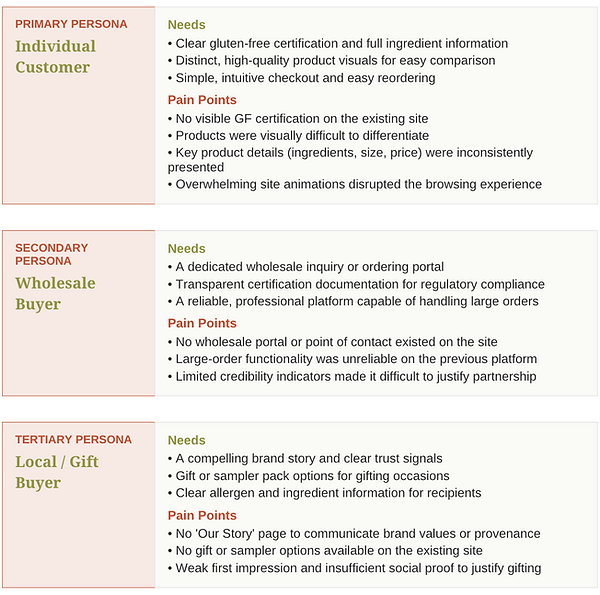
Based on the research synthesis, the team defined three key user personas — each representing a distinct segment of Emilia's Graces customer base. These personas served as reference points throughout the design process, ensuring that every decision served a real human need rather than an assumed one.
Findings and Implementation
With research complete and personas defined, the team translated insights into concrete design and development actions across three structured sprints. Each sprint built upon the last, moving from foundational branding through marketing execution to a fully functional e-commerce storefront.
Sprint 1 - Brand Kit (Presented to Client on April 2nd)
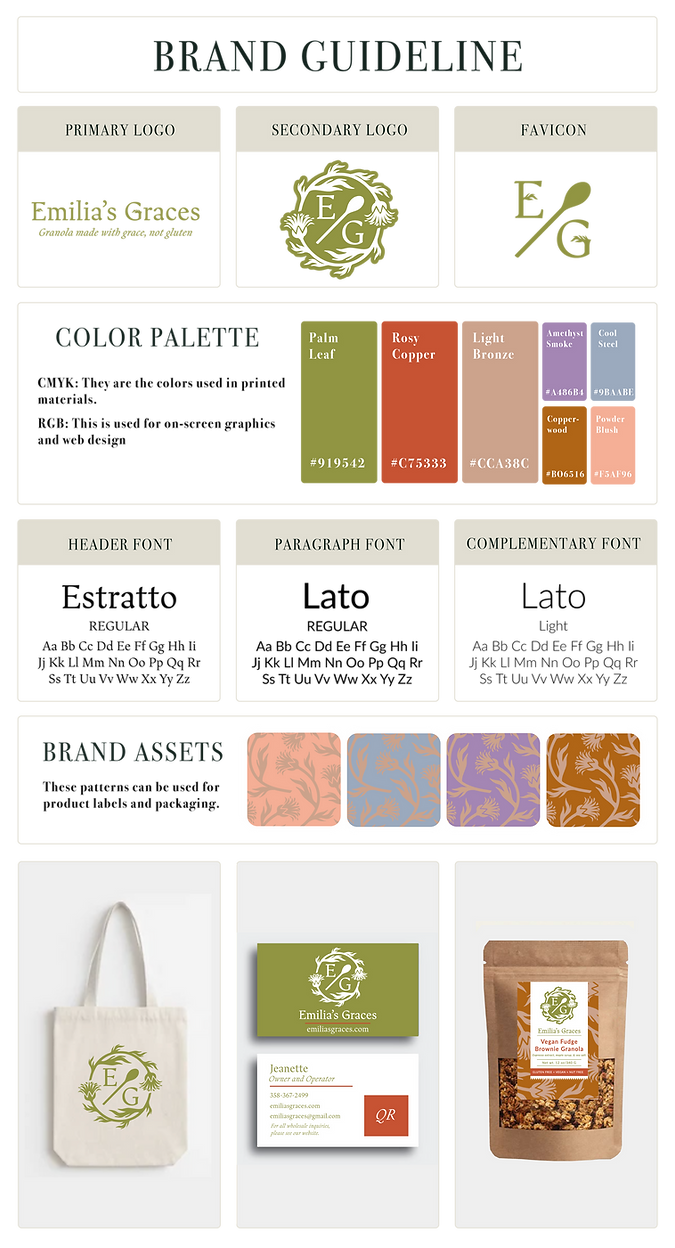
The first sprint established the visual and strategic foundation of the redesigned Emilia's Graces brand. Deliverables included a primary logo (with and without typography), a favicon, and the brand's new tagline: "Made with Grace, Not Gluten" — a phrase that captures the product's core value proposition with warmth and wit.
A formal color palette was developed around five primary tones: Palm Leaf (#919542), Rosy Copper (#C75333), Light Bronze (#CCA38C), Amethyst Smoke (#A486B4), and Cool Steel (#9BAABE). Supporting accent colors — Copperwood and Powder Blush — added depth for print and packaging applications. Typography was standardized around Estratto (headers) and Lato (body), creating a system that balances character with legibility.
Custom product labels and a business card completed the sprint, giving the brand a cohesive physical identity that mirrors its digital presence.
Sprint 2 - Product Marketing (Presented to Client on April 21st)
The second sprint focused on building the marketing assets that would give the new brand identity real-world expression. Professional product photography was produced for the full granola line, with consistent lighting, neutral backgrounds, and deliberate composition that allows each flavor to stand distinctly on its own.
Social media assets were developed for Instagram and Facebook, including a cohesive social grid, reusable Canva post templates, and a structured upload schedule. The content strategy was built around four content pillars: product spotlights, educational and ingredient-focused posts, behind-the-scenes content, and local event promotions. A live homepage demo was also presented, previewing the Shopify site in progress.
Sprint 3 - Final Deliverables (Presented to Client May 5th)
The third and final sprint delivered the complete Shopify e-commerce storefront — the centerpiece of the project. The site was structured around six core pages: Home, Shop, Our Story, Wholesale, Store Locator, and Contact. Each page was designed to serve a specific user need identified during research.
The homepage leads with the brand story and certifications, addressing trust and transparency immediately. The Shop page organizes the full granola catalog with clear product photography, flavor-specific labels, and dietary badges. The Wholesale page provides a professional inquiry pathway for B2B customers. The Store Locator solves the in-person accessibility gap by surfacing local retail partners. The Our Story page gives gift buyers and new customers the narrative context needed to feel confident in their purchase.

AI Coding and Final Conclusion
Throughout the project, the team strategically incorporated AI-assisted tools to accelerate development, improve quality, and expand what a three-person student team could realistically produce in a single semester.
Role of AI in the Development Process
Artificial intelligence was used at several key stages of the project — not as a replacement for human judgment, but as a force multiplier for skilled practitioners working under real constraints. The team approached AI tooling with intentionality, using it where it genuinely added value while ensuring that all strategic, creative, and brand decisions remained human-led.
Shopify Theme Customization
Building a fully custom Shopify storefront from scratch requires significant development time, particularly for liquid template modifications. AI coding tools were used to accelerate the customization of Shopify theme files, enabling the team to implement specific layout behaviors, section logic, and dynamic content blocks that would otherwise have required extensive trial-and-error. This allowed Ash Conley — serving as Shopify Developer — to move more efficiently from design specification to working code.
Copywriting and Content Generation
AI-assisted writing tools supported the development of product descriptions, the brand's 'Our Story' narrative, and social media post copy. These drafts were always reviewed, refined, and rewritten in the brand's voice by Ash Conley as Copywriter and Content Strategist. The goal was never to outsource voice — it was to generate quality first drafts faster, leaving more time for strategic refinement and brand alignment.
Design Iteration and Asset Generation
AI image and pattern generation tools were explored during the brand kit development phase, particularly for the decorative botanical patterns used in product labels and packaging. The team used generated assets as starting points for further refinement in Canva and Illustrator, ensuring that the final outputs were intentionally curated rather than generically produced.
Ethical Approach to AI Use
The team was transparent about AI's role throughout the project. All AI-generated content was disclosed to the client and reviewed against brand standards before use. No AI output was used without meaningful human editing and strategic evaluation. The team's position: AI is a tool, and like any tool, its value depends entirely on the skill and intentionality of the person using it.
Final Conclusion
Over the course of three sprints and a full semester, The Granola Girlies™ delivered a complete brand and digital transformation for Emilia's Graces — one that connects identity, marketing, and e-commerce into a single, unified system.
The project began with a clear and well-defined challenge: a growing business whose digital presence was no longer keeping pace with its potential. It concluded with a fully realized answer — a Shopify storefront that is intuitive to navigate, honest in its storytelling, and built to scale. Alongside it: a professional brand kit, a library of product photography, a structured social media system, and a suite of reusable marketing assets.
Every element was designed with Emilia's Graces' core identity in mind. The brand is local, handmade, and community-rooted. The redesign honors all of that — it simply makes those qualities more visible, more accessible, and more compelling to the audiences who need them most.